Introduction
Camera make and model: Sony Cyber-shot DSC-V1
Review camera serial number: 865742
Average street price (6th April, 2004): UK£399, US$499, EU€525

The Cyber-shot DSC-V1 is currently Sony's highest-specification 'compact' digital camera model and boasts a 1/1.8 inch five megapixel Super HAD CCD sensor, which is a typical size for this category of camera.
Notable competitors include the Nikon CoolPix 5400, Olympus C-8080WZ and the Canon Power Shot G5.
General features
Top of the list of features offered by the V1 is its Carl-Zeiss designed 7-28mm Vario-Sonnar lens with a zoom range equivalent to 34-136mm (4x). That's an improvement in range compared to the V1's predecessor, the Cyber-shot DSC-S85 (3x) but is only about average among the current competition.
At its widest setting, the V1 is at a disadvantage compared with a few competitors that cover a wider field of view, like Nikon's CoolPix 5400 and the Olympus C-5060WZ, for example. These go as wide as 28 and 27mm, respectively. The V1's lens brightness is also average, f/2.8 at the wide end of the zoom range and f/4 at the other extreme.
Measured from side to side, the V1 certainly boasts a compact dimension of just under 100mm. However, unlike its new T1 sibling, the V1 is not a slim camera, feeling almost box-like in the hand, but it does feel light in its satin aluminium skin.
Users that require wide-ranging control over camera settings are catered for well by the V1. Full manual mode, plus shutter and aperture priority and fully programmed automatic modes are provided.
A nice touch is a super-simple programmed auto mode that you can select instead of the standard Programmed mode. You also get a selection of scene-specific auto modes. ISO sensitivity can be manually set between 100 and 800 or fully automatic.
The built in pop-up flash has a slow sync mode and a dedicated hot-shoe is provided to accommodate a more powerful external flash unit, like the Sony HVL-F32 which sells for around £130.
A well-specified autofocus system can be set to multiple focus points or a single central point.

The V1 uses a compact smart lithium ion battery
For power, a compact 3.6V 2.8Wh smart Infolithium Li-ion rechargeable battery is used. Being a smart monitored battery, the V1 can indicate how many minutes of battery life remain.

Here you can see a memory stick half inserted into its slot next to the battery.

This shows the relative sizes and positions of the battery and memory stick.
Sharing the same compartment is the V1's Sony Memory Stick card slot. Like all the latest Sony's, the V1 is compatible with both 1st-generation Memory Sticks and the latest faster and higher-capacity Sony Memory Stick Pro cards.
Special features
The V1 is not short of relatively unusual features. For example, like its F717 and F828 siblings, the V1 uses a three dimensional laser (harmless) hologram projection for low light focus assist.
Two modes for low light shooting are also provided. Night Framing switches out the camera's internal near-infra red filter and switches on an infra red illuminator. The result is a ghostly monochrome view using the LCD viewscreen, but it means you can actually see
something.
When pressing the shutter home the ir filter is reinstated with a click and the picture is taken in full colour. Shutter lag is something to watch in this mode. However, in conjunction with the holographic AF assist and flash, Night Framing works very effectively. Night Shot mode very similar, but the picture is taken in mono ir mode and there is no flash or holographic AF assist. Night Shot is ideal for use when it’s very dark and you don't want to use flash.
Notable features missing
In this category, buyers are looking for features like a flip-out viewscreen monitor for low or high angle shooting, dioptre-adjustment for the eye-level viewfinder, a RAW image format option for maximum flexibility in image processing and, maybe, programmable buttons and custom functions. You won't find any of these on a V1.

Click here for details of Peter iNova's must-have eBook covering the top Sony Cyber-shot cameras, including the V1.
Controls and design
 Innovation
Although not the first Sony camera to feature Night Framing and Night Shot modes, plus holographic AF assist, these features are certainly innovative.
Build quality
While the V1 is put together well enough, its lightweight feel is odd and doesn't provide that comforting feel of robustness that is imparted by heavier cameras. The satin aluminium finish doesn't look like it will stand up well to the test of time and our review example has already recorded some marking.
Controls

The off-set to the right eye-level viewfinder is odd as it means you have to squash your nose up against the viewscreen. Most modern digital cameras site the viewfinder well to the left.
One main top-plate knob selects exposure modes, playback modes and the central set up mode. A single settings adjustment jog-dial thumb-wheel is provided just above a four-way navigation cluster that doubles as a mode selector for the flash settings, close focus modes, self-timers and a toggle between live preview and reviewing the previous picture taken. In the centre of the cluster is a fifth button but this doesn't appear to do anything most of the time. It does, however, serve to confirm settings choices when in main setup mode.
 1.Exp compensation, 2.AF mode, 3.AE Lock, 4.Hot shoe, 5.Viewfinder, 6.Viewscreen on/off/histogram, 7.Night Frame/Shot, 8.Exp mode, setup knob, 9.Zoom, 10.Jog/dial, 11Up nav/flash, 12.Setup confirm, 13.Right nav/close focus, 14.Down nav/self timer, 15.Battery/memory stick compartment, 16.Resolution/erase image, 17.Menu, 18.Left nav/review, 19.Viewscreen, 20.Cover for external ports.
Above the cluster is a button that switches the viewscreen on and off as well as select a live histogram display. Below the cluster are the menu button and a shortcut button to the resolution menu setting in picture making mode or delete image function in playback mode.
 1.Threaded accessory lens mount, 2.Viewfinder, 3.Shutter release, 4.Speaker, 5.Laser Holographic AF assist, 6.Flash (closed), 7.Self-timer lamp, 8.Infra red illuminator, 9.Lens (automatic cover).
Finally, three buttons to the left of the viewfinder eyepiece provide control for +/- EV override in shooting mode and thumbnail view in playback mode, focus mode selection and auto exposure (AE) lock.

It looks innocent enough but I found the V1's vertical zoom knob tricky to use at first.
The zoom control is a stubby vertical action thumb-operated lever. I found this quite difficult to get used to. Most compact cameras let you control the zoom with either a left/right thumb switch, or a forefinger-operated collar switch incorporating the shutter release button.

The V1's zoom lens doesn't extend in an extreme fashion through out its zoom range. Note the proprietary accessory port in the centre of the side of the body.
The V1's lens is of the type that is recessed when not in use, extending when the camera is switched on in picture taking mode. Zooming does vary the lens extension but this not extreme.

Ports

Three main ports are hidden under a flap to the left of the LCD viewscreen.
The three primary external connections offered by the V1 are the mini-USB 2.0 Hi-speed port, A/V composite video and mono audio 3.5mm jack socket and a proprietary power socket for the bundled mains adapter that charges the battery while it remains in the camera. There is also an accessory port on the left hand side if the body viewed from the back.
Software
Sony's bundled software is very basic, including a picture transfer manager utility and a beginner's image viewing and tidying up program called Pixel ImageMixer.

Click here for details of Peter iNova's must-have eBook covering the top Sony Cyber-shot cameras, including the V1.

 Ease of use

Settings
For a relatively small camera, a good number of settings can be chosen without resorting to menus. The thumb-operated jog/dial works well, too. Sony menus take some getting used to as you don't need to confirm a setting once you have indicated it on the screen. Somewhat confusing, settings chosen in menus presented in setup mode do require confirmation using the centre button in the nav cluster.
Status information
There is no dedicated LCD status screen. Everything is displayed using the rather small 1.5 inch LCD viewscreen monitor and the numerous status indicators are scattered around the screen. The advantages of a dedicated status display is that it is on all the time the camera is powered up, it uses less battery power and usually you can find what you need to check more easily. On the V1 there is simply no room for this, but it must be marked as a disadvantage.
Speed of operation
Power-up and power-down rapidity is not a V1 selling point. Each operation takes the best part of 4 seconds. That may no sound a lot, but it can feel like an age in practice. Single shot to shot time is about one second, which is adequate. There is a 3-shot continuous burst mode setting, which takes three pictures in about 2 seconds, but then ties the camera up for about 10 seconds as the images are written to the memory stick. If you use TIFF mode, for maximum image quality it takes a whopping 43 seconds before control is returned to the user. Our timings were with standard 128MB memory sticks and the transfer times are likely to be swifter using a Pro-class memory stick.
Handling

Note the almost unfashionably compact mini-grip on the front right of the V1 body.
There is plenty to hold on to with the V1 even though it is a small camera. Its depth helps here. Controls are generally well-positioned and easy to find, if rather on the light side.

The relative depth the of camera with respect to its narrow width and modest height are betrayed by this underneath view.
Focus
In general the V1's AF system does a good job, especially in low light in conjunction with the hologram AF assist system. The AF mechanism is very quiet and reasonably swift to lock on. You can switch between continuous AF and single-shot modes. The latter is set by half depressing the shutter release. There isn't much latitude when doing this and it's all to easy to end up taking a picture when all you wanted was a focus lock.
Besides autofocus, you can switch to manual focus mode, operated by the jog/dial using your thumb. This is accompanied by a distance scale on the viewscreen.
Zoom
As previously mentioned, the vertical zoom control takes some time to get used to. Zoom speed is about average and there is no accelerated zoom facility. Zooming operates at just one speed. We detected 15 steps throughout the zoom range, which is about what to expect. A step-less zoom is not offered, as far as I know, in any cameras in this category.
Flash

Almost the entire quarter of the top plate rises up to reveal the pop-up flash. It's easy to accidentally prevent the flash from popping up because of its position and because the pop-up spring is too weak.
The built in pop-up flash is more than adequate for general purpose indoor snap-shooting. One problem is that the top of the flash unit, when recessed, occupies a large chunk of the top plate of the camera, just where some instinctively rest a finger or two. The spring action of the pop-up unit is weak and I found myself accidentally preventing the flash unit from automatically deploying on several occasions. The fact that there is a dedicated hot shoe is a definite plus.

Flash with red-eye reduction off. Red-eye is clearly visible.

Flash with red-eye reduction on - and it works.
Flash red-eye reduction really works with the V1, which is just as well as if you don't use it you may wish you had! The second picture, above, was also shot with the slow-sync option selected and this is why the background has lightened up - a useful feature to have.
Click here for details of Peter iNova's must-have eBook covering the top Sony Cyber-shot cameras, including the V1.
Image Quality
 Framing accuracy

The red area shows what was covered by the LCD viewscreen.
In our tests, approximately 2500x1900 of 2592x1944 recorded image pixels image represented the scene viewed using the V1's viewscreen monitor. That makes just under 300K pixels wasted, or just under 6% - a fair result.
Colour
My experience of colour reproduction with Sony digital cameras is quite distinct. In Japan, colour preferences are actually different to European and other general Western tastes. My personal theory is that while other Japanese manufacturers have successfully tailored their exported cameras with the preferences of the target market in mind, Sony has, to an extent, remained more influenced by its home market. The V1 is much as I expected, with greens on the cool side, slightly lemony yellows and pinkish skin tones. This is all very subjective, but it's what I see in the pictures and I think it's illustrated well in the colour charts below:
Gretag Macbeth DC Color Chart

Sony Cyber-shot DSC-V1

Canon Power Shot G5
All the Sony V1 colours are relatively muted and cool compared to those produced by the Canon G5. Some would argue that the Canon produces slightly over-saturated colours, but that's beside the point here – the main point being that there is a significant difference.
Fluorescent colour

Fluorescent colours
As part of the test routine we now include a simple series of fluorescent colours, as above. It's quite difficult to reproduce fluorescent or DayGlo colours via either traditional colour film or digital means. Here, the yellow and green cards have a slight fluorescent feel to them, but the orange and red cards look quite flat.
Skin tones

Test for skin tone reproduction.
Illuminated by indirect mid-morning Spring sunshine, the facial tones here are slightly cooler than they should be, with a slight pink bias. This is similar to results from other Sony models I have tested recently, including the F717 and P51.
Skies

Blue sky and clouds.
There are no complaints here. The blue of the sky is accurately reproduced and there is no contamination of the white clouds.

This picture underlines how well the sky blue is captured in a cloudless situation.
Nature

The warmth of some late afternoon winter sunshine has helped combat the V1's tendency towards coolness.

But here the familiar cool yellows and greens make their mark once more.
Reds and browns look better with the V1 than yellows and greens because of the natural coolness of the V1's colour bias. This can be adjusted by experimenting with the white balance settings but it shouldn't be necessary.
Exposure metering
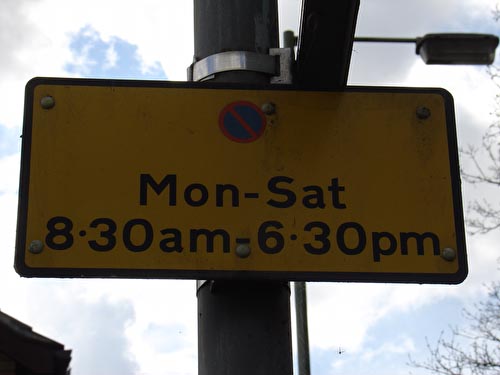
Even though the sign dominates the frame and matrix metering is being used, it has still come out as a silhouette.
In general, the V1 copes well with normal lighting situations. The main area it gets caught out in are with strongly back-lit scenes like the one above.
White balance

Under low wattage fluorescent illumination, the V1's auto white balance system doesn't do a perfect job of eliminating the expected greenish-yellow cast, but it's not any worse than most, to be honest.

Under ordinary light bulb illumination, the V1 does a passable job of optimising the white balance automatically. There is no excessive redness that could be expected, though there is a slight warmth about the whites.
In general, the V1 does a good job of automatically adjusting white balance under artificial lighting of most types.
Sharpness
We will be shortly be adding computerised
DXO Analyzer testing for, among other things 'perceived' sharpness as this gives a different and more easily digestible view on image sharpness than the ISO resolution target results, below:

ISO resolution chart, 57mm (equiv.) f/3.2

ISO resolution chart, 57mm (equiv.) f/4
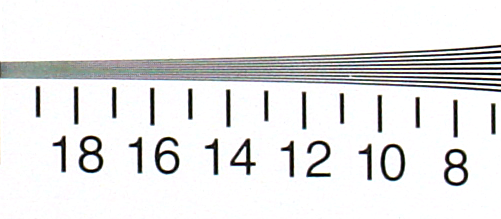
ISO resolution chart, 57mm (equiv.) f/5.6

ISO resolution chart, 57mm (equiv.) f/8
The ISO chart results show that the V1 has very good resolving power, even at almost full aperture, though there is a detectable drop off at the smallest aperture available, f/8, which is to be expected.
Noise
Again,
DXO Analyzer testing will give us a different view on image noise, but here is a more subjective comparison:
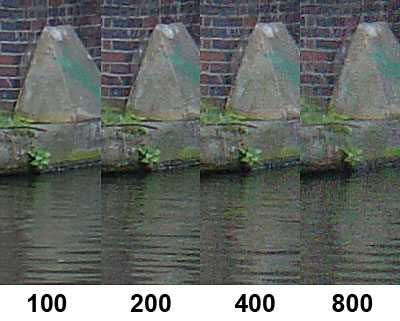
Noise at ISO 100 is well controlled, but evn by ISO 200 it's presence is felt and the problem steadily worsens up to ISO 800.
Chromatic Aberrations
We don't currently have a test for optical chromatic aberrations, but the V1's Carl-Zeiss Vario-Sonnar lens design didn't throw up any obvious concerns in the pictures we took.
Chromatic aberration testing is a key feature of our new
DXO Analyzer suite, which will be introduced into dpnow camera testing as soon as we are happy it's set up correctly.
Fringing
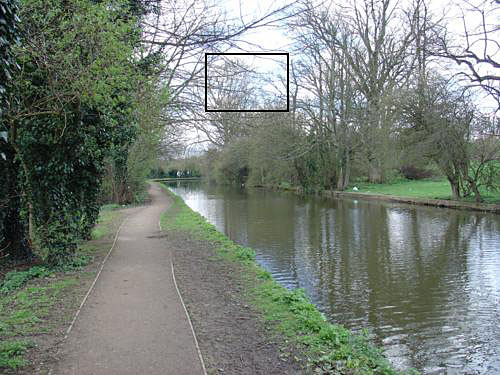
The boxed area above is reproduced below at 100% (1:1 pixels).

Even close to the centre of the frame, some blue and purple fringing in the tree branches is evident. Most cameras in the V1's category are prone to this problem, but there are signs that some manufacturers are deploying some clever image processing to control fringing.
Lens flare

Even without Carl Zeiss' best T* lens coatings, the V1's lens copes will with flare.
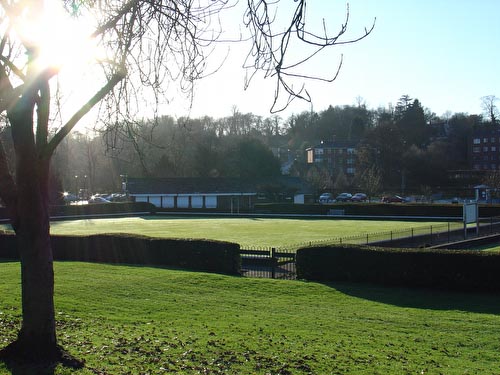
You really have to provoke the situation to let flare in.
Distortion

34mm (equiv.) widest zoom setting.

63mm (equiv.) mid-zoom setting.
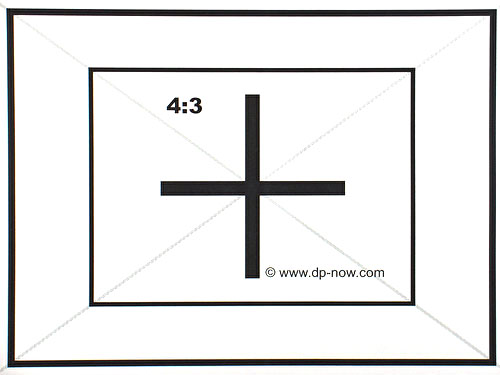
136mm (equiv.) full tele setting.
This is a good performance. At the widest setting there is some fairly obvious barrel distortion, but this is to be expected. By the mid-zoom setting the sides are almost straight and at full zoom there is only a hint of pincushion distortion. This is another test that will be eventually replaced by our new DXO Analyzer suite.
Close focus

Closest focus with 'macro' setting at widest zoom setting.

Closest focus with 'macro' setting at fullest tele zoom setting.
There is no point using the 'macro' mode using the wide end of the zoom. Either end of the zoom range will be limited to about 12cm, or more, lateral coverage, which is not particularly competitive. Another advantage of using the longer end of the zoom range for close focus work is that there is less distortion.
Movie mode
Movie resolution of up to 640x480 (VGA) is heralded by Sony. Compared to some digital still cameras, the 'VX' MPEG quality that the V1 is capable of is very good. Picture noise and digital artefacts are well controlled and the sound quality is good. But there is insufficient frame inter-leaving, so the motion can get jerky and the sound is mono-only. Zooming is not possible while recording a scene.
A 10 second clip can consume up to 4MB of space on your memory stick, meaning 128MB is probably only good for five and a half minutes of recording. The viewscreen does estimate how much recording time is left on the card, however. A quarter resolution mode for use with email is also provided.
Click here for details of Peter iNova's must-have eBook covering the top Sony Cyber-shot cameras, including the V1.
Technical Specifications
Manufacturer's technical specifications for:
Sony Cyber-shot DSC-V1
|
LENS |
|
Optical Zoom/Smart zoom | 4x/up to 16x (VGA) |
| F | 2.8-4.0
|
| Focal Length f= 35mm conversion | 7-28 mm
34-136 mm
|
| Conversion Lens Compatibility | yes
|
| Lens Type | Carl Zeiss Vario Sonnar
|
| NightFraming | yes
|
| Even Brightness picture | yes
|
| CCD
|
| CCD Type | Super HAD CCD
|
| Inch size | 1 /1.8 type
|
| CAMERA
|
| Effective pixels | 5.0 Mega
|
| DXP | 14bit
|
| Super Resolution Converter | yes
|
| Clear Colour NR/Clear Luminance NR | yes
|
| Auto Focus method | Single AF, Monitoring AF, Continuous AF
|
| Auto Focus area | Multipoint, Centre weighted, Spot
|
| Exposure control | +/- 2.0EV, 1/3EV step
|
| White balance | yes (7 modes)
|
| Light Metering | Multi pattern, Centre weighted, Spot meter
|
| Sharpness/Contrast/Saturation setting | yes/yes/yes
|
| AE Lock | yes
|
| Scene selection | yes (6 modes)
|
| Picture effect | yes (3 modes)
|
| Flash mode | Auto, Forced-flash, No-flash, Slow Synch
|
| Pre Flash | yes
|
| ISO sensitivity setting | auto, 100, 200, 400, 800
|
| Hologram AF | yes
|
| Manual mode | yes
|
| Aperture priority mode | Auto/Manual (F2.8-8.0)
|
| Shutter speed priority mode | Auto (1/8-1/2000)/Manual (30/1/1000)
|
| NR Slow Shutter | yes
|
| Histogram indication | yes
|
| Red-eye reduction | yes
|
| LCD viewfinder
|
| LCD screen size | 1.5-inch/123.000 dots
|
| Optical viewfinder | yes
|
| Auto Bright Monitoring | yes
|
| Recording
|
| Recording Media | Memory Stick/Memory Stick Pro
|
| Recording Mode | Normal (JPEG), Burst Mode (JPEG), Auto Bracketing (JPEG)
E-Mail (JPEG), Voice Memo (MPEG1), TIFF, Clip Motion
|
| MPEG Movie | VX
|
| Burst Mode | yes (3x)
|
| Multiburst | yes
|
| Jacks
|
| AV Out | yes
|
| Digital I/O (USB) | yes (Hi Speed USB 2.0)
|
| Advance Accessory shoe | yes
|
| General
|
| Dimensions (w x h x d) | 99.5 x 65.2 x 56.8 mm
|
| Weight (body/incl. accessories) | 270g/300g
|
| STAMINA** time/nr. of shots | 1hr 25 min./170 shots
|
* Subject to error and technical changes
** Still image recording: under normal shooting conditions: LCD on, shooting once every 30 seconds, zoom operation alternately between the W and T ends., Flash strobes once every 2 shots, power turns on and off every 10 shots.
Conclusions
 dpnow review ratings explained
Percentages and other number-based ratings can be interpreted very widely by different reviewers and readers. This is why our rating system presents category-specific values in relation to a median. It's a bit like exam scores, where A or A+ is the best, C is the minimum pass and on to F, for failure. You can also see at a glance each rating value through a traffic-light colour code, with green for go - meaning good, amber or yellow for be cautious and red for stop. Click
here for further information about dpnow.com product ratings.
Features

The Sony Cyber-shot DSC-V1 bristles with cutting edge features, like the laser holographic AF assist, Night Shot and Night Framing modes and a full range of creative controls. But the V1 lacks some surprisingly basic ones too for camera of this class, including RAW file format, flip-out LCD viewscreen, eyepiece dioptre adjustment.
Design and construction

When you first set eyes on a V1, it signals something rather special. The front of the camera looks very stylish and distinctive. The back, looks a little less so. Pick a V1 up and it strangely light. The fine detailing is not bad, but Sony has done better design work before.
Handling and ease of use
Once you get used to it, the V1 is a fairly easy camera to use. However, the small viewscreen and scattered status information could be improved on. Creative control is very comprehensive and many controls are easily accessed without wading through menus. When you do need the menus, navigation can be tricky and that zoom lever is certainly unusual. The ease with which the flash pop-up mechanism can be prevented from deploying is a serious design flaw.
Image quality
Sharpness and distortion control are both very good and the lens acquits itself well when faced with flare-inducing conditions. It’s the subjective quality of colour reproduction that I'm less positive about the V1.
Speed of operation

Operating the V1 is a very serene and quiet experience, but it's not particularly fast. Powering up and powering down takes 4 seconds apiece when there are cheaper cameras doing the same in less than a second. But the general responsiveness of the camera is not too bad unless you opt for the TIFF mode, which makes you wait over 40 seconds between shots.
Autofocus
The V1's autofocus system is reasonably quick, usually accurate, especially in low light with the holographic assist and there is a usable manual focus facility. Its operation is quiet, too.
Value for money
When the Sony DSC-V1 was first introduced it was rather over-priced. Now the price has dipped below £400, it can be seriously recommended as long as the question marks raised concerning colour are considered carefully.
Things we liked about the Sony Cyber-Shot DSC-V1:
Night Framing facility
Laser hologram AF assist
Image sharpness
Low distortion
Resistance to flare
Comprehensive range of creative control options
Flash hot shoe
Dependable and quiet AF
Overall quiet and refined operation
Now more competitively priced
Things we didn't like:
Cool colour balance
Slow power up and power down times
Very slow TIFF image write time
No RAW file format option
No flip and tilt LCD viewscreen
Small LCD viewscreen
No status information panel
Scattered status information on viewscreen
Pop-up flash spring action too weak
Uncompetitive close focus range
Zoom lever unintuitive
Lightweight, boxy construction
Eye-level viewfinder too far to the right
No viewfinder dioptre adjustment
Battery stamina only average
Battery must be charged in-camera
Last words
The Sony DSC-V1 is a very good camera that could easily have been significantly better. Its compact, but boxy, lightweight design may not be to everyone's tastes, but image quality is mostly very good. If you seek unusual features, the laser holographic AF assist and Night Shot and Night Framing features may be enough to tip the balance.

Click here for details of Peter iNova's must-have eBook covering the top Sony Cyber-shot cameras, including the V1.
Buy your camera through dpnow affiliate partners
Our affiliate partners, Amazon.co.uk and the Digital Camera Company, list the Sony Cyber-shot DSC-V1. If you purchase this camera from our partners via the links below, you will earn a commission that will be reinvested in this Web site.

The Digital Camera Co
Check the latest price or purchase this item via

|
|
|
|  |
| Click on the flag that best relates to your location |
| The EU flag links to Amazon Germany, currently the only European Amazon outlet that supplies electronic goods like cameras priced in Euros. |
| Each Amazon outlet can ship to most countries in the world. |


