Epson Toyocom Develops New Type of OLPF with Wide-Band Phase Retardation Film
TOKYO, Japan, September 6, 2007 - Epson Toyocom Corporation today announced the commercial development of a new optical low pass filter (OLPF) for digital cameras. This OLPF features a new structure that enables the uniform separation of light rays across the visible spectrum.
Digital camera pixel counts continue to climb, and market demands for higher image quality are on the rise. An optical low pass filter is often provided on digital cameras to combat moiré patterns*1. Conventional OLPFs employ a construction containing three quartz plates. The three-quartz plate system, however, does not provide uniform light separation characteristics at certain wavelengths, and thus not all moiré patterns are eliminated. Epson Toyocom's latest OLPF employs a new structure wherein a wide-band phase retardation film is sandwiched between a pair of quartz plates (Fig. 1). This design provides uniform light separation at all wavelengths of visible light (Fig. 2) and is thus able to eliminate moiré patterns across the visible spectrum. The new OLPF is also thinner and lighter than the conventional structure because it requires only two quartz plates.
As a result, this new OLPF will further boost the image quality of digital cameras and enable them to be made thinner. The lighter weight of the new design also makes this OLPF ideal for CCD-shift camera-shake correction mechanisms and for functions designed to physically vibrate dust off the filter.
The new OLPF and other crystal devices will be on display at the Epson Toyocom booth (No. 6E116) at CEATEC JAPAN 2007, to be held at Makuhari Messe from October 2-6.
*1 Moiré patterns
A lined pattern that appears when two regularly spaced sets of repeating lines are superimposed. A moiré pattern may appear in digital photos when a pattern in a subject is superimposed on the pixel array of a digital imaging device.
Fig. 1 Sample OLPF structure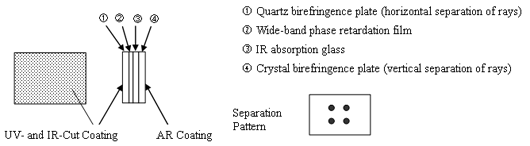
Fig. 2 Ray separation of new and conventional OLPF designs
| Wavelength |
White light |
479 |
546 |
586 |
643 |
| New OLPF with wide-band phase retardation film |
 |
 |
 |
 |
 |
| Conventional structure with quartz phase plates |
 |
 |
 |
 |
 |
Moiré patterns occur when the geometric pattern of a photo subject changes at a narrower spatial frequency than that of the picture elements ("pixels") of a CCD or CMOS sensor. Using the ability of quartz to separate light rays, the OLPF divides and regulates incident rays so that they strikes surrounding pixels. Fig. 2 shows that whereas the conventional OLPF is unable to uniformly separate light incident on the area where lines intersect, the new OLPF is able to uniformly separate the incident light and thus eliminate moiré patterns.
Reader feedback:
Discuss this story:


