Nokia's Lumia 1020 smartphone has an exceptional camera
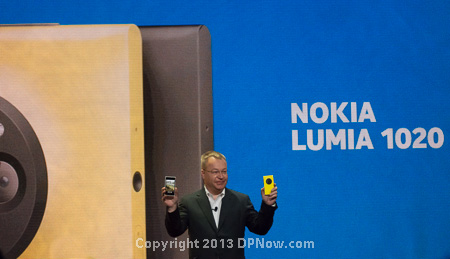
Nokia's CEO, Stephen Elop, unveils the new Nokia Lumia 1020 in New York
Nokia may be an iconic mobile phone brand struggling to survive, but the new Lumia 1020 smartphone launched by Nokia at a big press event in New York yesterday is evidence that the company is working very hard to not only survive but prosper as the industry's leading producer of photography-centric smartphones. The 41 megapixel camera technology inside the Lumia 1020 is literally years ahead of the competition. Don't think this is the megapixel race gone mad - if you're going to have such a densely packed camera sensor as this, you would do exactly what Nokia has done with the 1020.
Pureview improved
At the beginning of 2012 Nokia unveiled the 808 Pureview, featuring the largest image sensor in any smartphone and by some large margin the most megapixels - 41 megapixels. To put that into perspective the Nikon D800, the highest resolution DSLR camera at the moment, falls just shy of 37 megapixels. Publications like us have routinely warned that the 'megapixel race' is to be taken with a pinch of salt. Over-crowding a sensor in a conventional camera can often lead to problems for a number of technical reasons. But Nokia proved with the 808 that a smartly engineered super-high resolution sensor can be a great thing, especially on a small device like a smartphone. The 808 uses the 41 megapixels to provide the user with a high quality digital zoom. 'Digital zoom' is another term that serious photographers might sneer at, but that would be a disservice to Nokia’s Pureview technology.
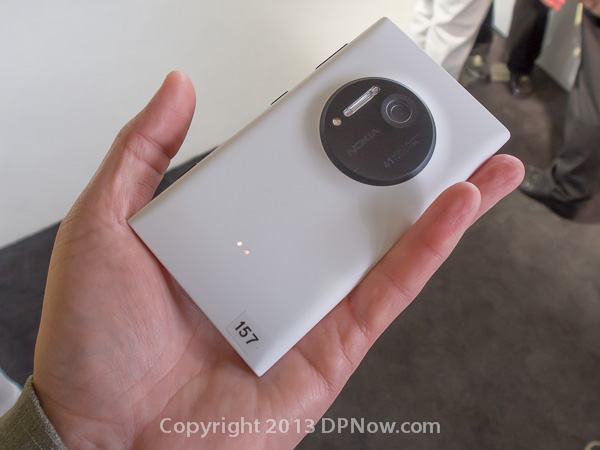
The Nokia Lumia 1020 shows its front - note the Xenon flash
With such a high resolution sensor Nokia samples the sensor data to produce clean and clear images with pixels that may be constituted from up to 7 surrounding pixels. The process distils the 41 megapixel source data into good quality lower resolution images and in the process reduces noise and, Nokia argues, improves colour reproduction because it uses more bayer filter colour pixels to build the colour in each final image pixel. In stills mode you get a 3x (25-75mm equivalent full frame zoom in 16:9 aaspect ratio) digital zoom and you now have the option of saving the original full resolution image file so that you can return to your shot after you have taken it and re-frame and zoom using the same controls on the smartphone as when you first took the picture.
The Lumia 1020 also provides a greater digital zoom range for HD movie mode. With 1080 full-HD movies you can zoom up to 4x (25-100mm equivalent full frame zoom) and 720 HD movies up to 6x (25-150mm equivalent full frame zoom). Other points include the inclusion of a traditional Xenon flash which is capable of freezing action unlike the usual smartphone staple of LED flash. An LED light is provided for video and other uses. New white balance processing has also been introduced with the 1020.
New sensor
The original 808 Pureview's 41 megapixel sensor was a 1/1.2 inch CMOS device. In order to reduce the size of the camera module the 1020 sensor is smaller - 1/1/5 inch - but it is a back-lit illuminated (BSI) CMOS device. BSI makes the sensor more efficient sensitivity-wise and overall sensitivity is roughly the same as the original sensor despite its smaller 1.1 micron pixel pitch. Once again Nokia has employed the concept of an over-size sensor so that the standard 4:3 aspect ration frame isn't simply cropped for 16:9 widescreen mode, so 16:9 uses as much of the available sensor area as possible.
New image stabilisation
Image stabilisation wasn't featured on the 808. The 1020, though, has a sophisticated lens-shift image stabiliser. This is like sensor-shift image stabilisation but instead of moving the sensor in two dimensions, the lens is moved. Technically this isn't optical image stabilisation (OIS) where only part of the optical make-up of the lens shifts to compensate for shake. In some ways Nokia's system is better because there is no optical compromise. IS has been featured in Nokia smartphones since the Lumia 920, using springs to locate the lens. Because the 1020 lens is relatively large the spring arrangement was no longer efficient and so Nokia developed a design that sees lens module rest on three tiny ball bearings.

From the left the camera modules from the Lumia 925, Lumia 1020 and the Pureview 808
New lens
Carl-Zeiss optics are once again featured and the 1020 now has a six-element design with one glass and five plastic elements. Previously, the 808 had an all-plastic 5-element lens. You get a slightly wider field of view with the 1020 compared to the 808; 25mm full frame-equivalent focal length compared to 26mm (16:9 aspect ratio). The 1020's lens is also a usefully bright f/2.2 and of course this doesn't change when zooming.
Improved microphone
If you're into boot-legging at concerts, the Lumia 1020 may be of particular interest because Nokia has paid particular attention to the built-in microphone's ability to record very loud audio without distortion. Combined with the image stabilisation and improved video mode zooming options, on paper at least the 1020 should be great for rock concerts and the like.
Interface and controls

Nokia has worked hard to incorporate controls a photographer would appreciate. There are a lot of manual options, including manual shutter speed selection. The touch-screen graphical user interface for the camera looks very intuitive although to get the best out of it you will have to learn some fairly simple gestures. The 1020 uses the 'Amber' update suite of photography tools and apps, many of which work better thanks to the better imaging the camera offers.
Design and construction
Finally we look at the design and construction of the 1020. Two things held back the original 808; its dependence on the old Symbian operating system and the rather chunky and heavy physical design, even though it looker robust. The 1020, at first glance, looks like Lumia 920. Rumours that the new phone would have a Lumia 925-style metal body were unfounded. It's another unibody design, so you can't replace the battery yourself if it should fail and apparently there was no space of a microSD card slot. However, there is 32GB of internal flash memory as standard. Nokia has successfully reduced the height of the camera and lens module so the 1020 is not as dumpy as the 808. Its larger screen also gives the appearance of a slimmer device. Colour options are white, black and yellow. All versions have a smooth matte finish which provides adequate purchase for secure fingertip handling.
As with the Lumia 925 there is no integrated wireless charging, although a clip-on wireless charger sleeve is available. There is also an extended battery cover that doubles as a camera grip. The extra battery adds 50% more power capacity to the 2000mAh battery in the 1020. The battery grip doesn't incorporate wireless charging either, apparently because you need close fit with the surface of the wireless charger, which isn't possible with the grip design.
Preliminary conclusion
Hands-on testing over a reasonable period of at least several days will be needed to realise a definitive verdict on the Nokia Lumia 1020. The use of Windows Phone as the operating system is definitely an improvement over good old Symbian but it may not be to everyone's taste. On the other hand the 1020 could be an important factor in popularising Windows Phone. However, the camera section does look state of the art and if the image quality is anything like as good as the 808, and we're expecting it to be even better, then the Lumia 1020 is probably going to be a great photographer's smartphone.
Pictures
Below is a picture gallery of Lumia 1020-related photos we took during the hands-on session at the launch event in New York.
To see a larger view of the the thumbnail, just click on the thumbnail image you are interested in to open a new page with the full-size view.
To return to the thumbnail gallery, click the home arrow at the bottom of the page, or navigate forwards or backwards through the gallery using the backwards/forwards arrow buttons.
Reader feedback:
Discuss this story:


