Can a sensor really work back to front? Well, sort of...
A term that you will be hearing more about in future is 'back-lit sensor'. The Ricoh CX4 we recently reviewed and Sony compact models, like the Cybershot DSC-HX5V employ back-lit CMOS sensors. So just what is a back-lit sensor?
The idea that the sensor is back-lit is really a bit of poetic license. You can't just turn a sensor chip around and expect to work back to front. But fundamentally, the idea is to improve the efficiency of very small CMOS sensor chips. When we interviewed Canon's director and deputy chief executive, Image Communication Group, Mr. Iwashita, at the PMA trade show in Orlando over five years ago, he explained the limitation of CMOS sensor technology for compact cameras: "CMOS has both advantages and disadvantages. The first advantage is superior power consumption. Secondly, although CMOS is known to be prone to image noise problems, we have fixed that. But the third point is that with CMOS, each pixel site on the sensor is surrounded by a circuit. The width of this circuit can not be smaller than a certain size. This means that even if the pixel size is reduced, the area required cannot currently be reduced. So it is not yet possible to make very small, high quality, CMOS sensors for compact digital sensors."

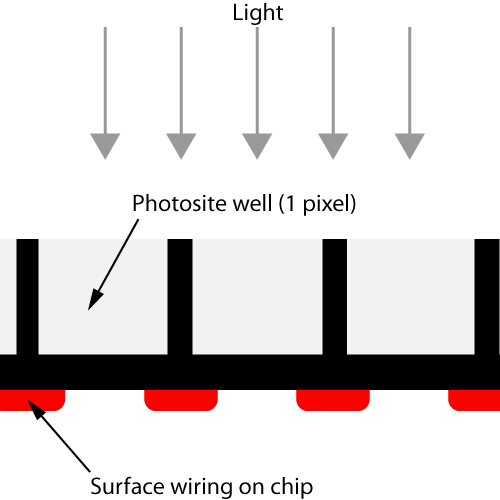
Here is a conventional CMOS sensor cross section of three photosite wells that represent 3 pixels.
The maximum width of the wells, and so their light gathering capacity, is limited by the (red) circuit
wiring on the surface of the CMOS sensor chip.
In other words, the matrix that makes up the pixel layout on the surface of a conventional CMOS sensor can't be made finer beyond a certain pixel pitch. The pixel pitch is the distance between each pixel space, from one pixel to the next, on the senor surface. And remember, pixel pitch is one thing, but the actual light sensitive area covered by the pixel pitch on a CMOS sensor is smaller than the total area because some of the pixel pitch area is taken up by the surface wiring required on a CMOS device. Microlenses above each photosite can gather more light and funnel it into the photosite well, but the diameter of the well also dictates the charge capacity of the well. The smaller the well, the greater the chance of it being filled to the limit and burned out pixels resulting, so producing a low limit for dynamic range.
So the thinking behind a back-lit sensor goes like this. Why be restricted by that inconvenient surface circuit wiring? Turn the whole chip around so that the back becomes the front. Shave off what was the base of the chip (and fill in the holes that used to let the light in at the other side, and you can make wider wells that have a greater area open to the incoming light and a larger volume for storing electrons, or charge, released by that extra light entering the photosite wells. So a back-lit sensor should be more sensitive and exhibit a wider dynamic range.
And here is a so-called 'back-lit CMOS sensor cross-section. In effect the sensor is now back
to front. What was the top of the chip, with the (red) surface circuit wiring, is now at the bottom.
Now, as you can see, that what was the bottom, or back, of the sensor can be opened up and the
photosite wells are no longer limited by the encroachment of the circuit wiring. With a larger volume
and entrance, the wells can collect and store more charge from more photons entering the well.
This means increased sensitivity even though the pixel pitch has remained unchanged.
First of all this orientation of the sensor chip structure enables considerably more sensitivity for the same pixel pitch. Increased sensitivity should mean less noise for a given operational ISO setting. But also, and perhaps most crucially for compact cameras that have tiny sensors, the pixel pitch of the sensor can be scaled down much further, enabling smaller CMOS sensors to be made suitable for compact cameras.
Reader feedback:
Discuss this story:


