In this week's Manual Focus column: many want the legacy of 35mm film to live on in the digital age. But don't count me in!
Discuss this article on the Digital Photography Now discussion forum
I don't know about you, but I find that the current generation of affordable DSLR cameras and, indeed, many of the better compact point and shoots, produce better pictures than anything I was able to manage with 35mm film and that says a lot after my 30-odd years of experimenting with hundreds of different cameras and lenses plus different film and paper developer chemicals and techniques. Digital is 'different' to film, of that there is no doubt, but I do wonder if we all became rather too used to what film delivered.
I certainly don't say that film can't produce great results; a fellow journalist and well known digital imaging technical guru confided in me that he had purposely photographed the birth of his new baby using film instead of digital. It was a considered choice and I respect that. For me and Julia, our first daughter's arrival in 1996 was recorded on film and our second daughter's birth in 1998 was all-digital! I sometimes joke that I have one analogue daughter and one digital one. After a shaky start, and in 1998 things were still very shaky, digital photography has really come into its own and, for me at least, there is no looking back; I only shoot the occasional roll of film out of curiosity or to provide some technical comparisons.
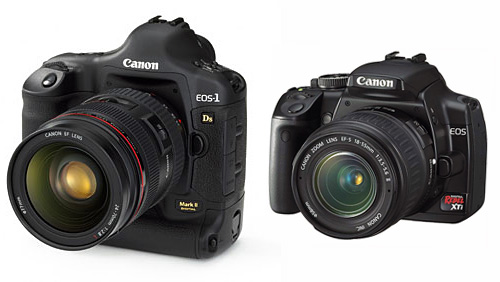
Meet the new new medium format (left) and 35mm (right) DSLRs.
Film is still superior?
There are still people around who insist on demonstrating how film remains superior to digital, especially when compared to smaller format sensor cameras. For these people, only a 'full frame' digital camera, one sporting a sensor as large as a 35mm format full frame, would be acceptable and while it may not be affordable now, they have convinced themselves full frame will become cheap in time because technology always delivers in the end. I have never subscribed to this and I can recall, not long ago, a vociferous chorus of derision greeting my comments on newsgroups and discussion forums where I dismissed the notion that truly affordable full frame digital cameras could ever become a reality.
My view was shared by almost everyone I discussed it with in the camera industry. Only a few people from Canon remained optimistic about the possibility of delivering full frame digital cameras to the masses. But even they have retreated from this point of view despite coming closest with the Canon EOS-5D. This camera is competitively priced – but only if you are comparing it with top-class professional digital cameras, but its full frame of12.8 megapixels is well on the way to being four times the cost of Canon's new 10.1 megapixel small-sensor EOS-400D.
Big sensors will always mean big costs
The semiconductor reality is that the single largest component cost in a DSLR camera, by a large margin, is the sensor chip and the larger that chip gets, so its cost rises exponentially. Memory and microprocessor chips have remained low cost because although their designs have become increasingly complicated, the physical sizes of these chips have remained small. Manufacturing faults affect less of a percentage of the smaller chips produced, making yield from each silicon wafer much higher than for 'monster' chips like full frame sensors.
The EOS-5D has a fairly modest specification for its price, apart from the sensor, which probably costs more than ten times that of the EOS-400D's smaller sensor. Of course the EOS-5D produces great images and trounces smaller sensor format DSLRs in many image quality departments, especially for dynamic range and high ISO performance.
But if you accept my argument that mass market DSLRs produce better quality images than 35mm film cameras of old, then does the extra quality that a full frame DSLR really matter that much. The instinctive answer is, yes of course! We all want as much quality as we can lay our hands on. That's human nature. But the other reality is that only a tiny percentage of us can justify a 300-400% full frame price premium. And to those that believe technology will be their saviour; sorry, but no matter how much cheaper chip makers will be able to squeeze the costs on large sensors, those same cost savings will be magnified when applied to smaller sensor manufacturing. In other words, affordable DSLRs will become even more affordable while larger sensor DSLRs will simply be slightly less unaffordable for most. If anything, technology will narrow the quality gap between larger and smaller sensors as there is more quality to be gained with technical improvements to smaller sensors.
Analogue and digital lenses
And there are other issues that do the full frame digital lobby no favours. Much of the pro-full frame momentum was driven by dissatisfaction with having to write-off much-cherished lenses that no longer fulfilled their original purpose because of the cropping factor in smaller sensor cameras. On a Canon EOS-400D, for example, a coveted 24mm extra wide angle lens suddenly becomes a less than inspiring 38mm, in effect.
To add insult to injury, the classic optical designs of older lenses often leave their mark when used with digital cameras, exhibiting some darkening of the corners of the frame and some resolution loss in the same areas. Optical redesign of lenses to optimise their performance with digital cameras has been accepted across the industry. Sigma, for example, has redesigned practically its entire range of lenses. Meanwhile, completely new lens designs specifically for smaller sensor DSLRs are now the norm for Pentax/Samsung, Nikon, Sony and Olympus. Even Canon has belatedly introduced its EF-S lens family for small sensor EOS models, though it continues to produce full frame lenses as well.
Full frame is the new medium format
So am I saying that full frame digital cameras are dinosaurs just waiting for the knock-out blow? Actually, no, far from it. Forget about affordable full frame DSLRs; small sensor DSLR systems are far too good and too successful in the market – they are here to stay, leaving no room for mass-market full frame digital cameras. Where full frame digital's future lies is in the old medium format film sector. Thousands of Hasselblad, Mamiya, Pentax 67 and Bronica users have switched to Canon EOS-1Ds and EOS-5D cameras.
Full frame is the new medium format, while smaller sensor DSLRs very neatly fill the 35mm void. There are rumours that Nikon is going to enter the full frame market, its strategy somehow fuelled, perhaps, by the need to compete with Canon. After all, Kodak produced Nikon-based full frame DSLRs for the professional market. On the other hand, Kodak failed to make that business pay and has long since given up.


