Konica Minolta's new Dynax.Maxxum 5D looks like being one of the more interesting budget DSLRs on offer

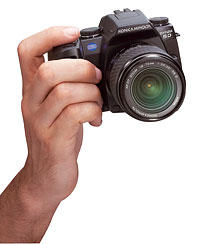
Nine months ago, many were lamenting a lengthy wait for Konica Minolta's debut DSLR. Today, Konica Minolta unveils the Dynax 5D (Maxxum 5D in the US and some other regions). This is the follow-up to Konica Minolta's first DSLR, the 7D. Priced in line with other budget DSLRs, the 5D also marks Konica Minolta's entry into the booming budget-priced DSLR sector, competing with the likes of Nikon's new D50, Canon's formidable EOS-350D, the radical Olympus E-300 and the compact Pentax *istDS.
Compare key specifications and pricing of the 5D with its main competitors.
Like most of its competitors, apart from the eight megapixel Canon EOS-350D and Olympus E-300, the 5D is equipped with a six megapixel sensor.
New standard zoom
To match the new 5D body, Konica Minolta has also introduced a new AF DT 18-70mm (27-105mm equiv) f/3.5-5.6 (D) standard zoom kit lens. A new bright (f/1.4) 35mm (52.5mm equiv) standard prime has also been unveiled today, while previously announced 11-18mm and 18-200mm DT-series (for DSLR models only) lenses have been reconfirmed.
Defining feature

Lens-independent DSLR image stabilisation remains unique to Konica Minolta
In this increasingly crowded sector, a defining feature to set you apart is crucial and the 5D has just that in the form of Konica Minolta's unique moving sensor anti-shake system, first seen in selected Konica Minolta fixed lens digital cameras and later, in the 7D. Konica Minolta is the only DSLR maker, to date, offering an anti-shake system that works with any lens fitted to the camera.
Sadly, but understandably, the UK press launch in London for the Dynax 5D, scheduled for last Monday, was cancelled because of the tragic events in the city on the Thursday before. This means we weren't able to enjoy the usual hands-on preview of the new camera and to discuss its features with Konica Minolta staff. However, what follows is the result of studying literature on the new 5D supplied by Konica Minolta.
The original Konica Minolta Dynax/Maxxum 7D is a feature-rich DSLR for enthusiasts and professionals and even at its newly discounted price of £999, with a kit lens, it's more than half as expensive again compared to its new sibling, the 5D. So what don't you get with the cheaper 5D?
Simpler, smaller, lighter

Immediately apparent is the absence of a plethora of different buttons and switches peppering the outside of the camera. This was the design ethos behind the 7D; to give the photographer direct access to as many camera settings as possible, minimising the need to navigate options menus. That's fine, even desirable, for a camera that is going to be used by an advanced photographer, the type of person the 7D is primarily aimed at, but it's exactly what less confident photographers, who make up the majority of the consumer DSLR ranks, don't need.
More compact dimensions and a significant drop in weight are significant hallmarks of the 5D compared to its 7D sibling. The 5D is not especially compact or lightweight compared to the run of the class in the entry-level DSLR sector, but its glass fibre plastic body construction, compared to the 7D's allow chassis, pares nearly 200g.
Dumbed down?
You might logically assume that the 5D is a dumbed-down 7D, but there are some powerful features retained in the 5D from the 7D. The first is the anti-shake system, which utilises a unique moving CCD sensor system, first seen in a DSLR in the 7D. Another 7D innovation retained in the 5D is Zone Matching, a system for preserving shadow and highlight detail in contrasty scenes.
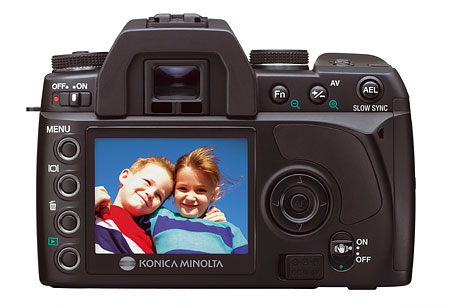
Again, just like the 7D, a 2.5 inch colour LCD monitor dominates the back of the 5D body, making it the joint-largest compact DSLR display, though the 5D's screen resolution is lower than the 7D's. Once again, there is no separate LCD status panel, so the big 2.5 inch colour screen serves as a status screen as well as the usual image review and menu navigation display.
As you would expect from a consumer-level camera, scene modes are provided under the grand title of 'Digital Subject Program Selector'. A healthy looking selection of effects options and controls are featured, including white balance bracketing.
On paper, at least, the 5D looks like one of the more interesting budget DSLRs. We certainly look forward to testing one.
Specifications Compared
| Model | Konica Minolta Dynax/Maxxum 5D | Konica Minolta Dynax/Maxxum 7D | Canon EOS-350D (Digital Rebel XT) | Nikon D50 | Olympus E-300 (Evolt) | Pentax *istDS
|
| Typical price (UK)* | £649.99** | £899.99** | £649 | £649 (msrp)** | £579 | £669
|
| Typical price (USA)* | TBA | $1299 | $929 | $899(est) | $799 | $899
|
| Typical price (Euros)* | TBA | €1099 | €819 | €971 (msrp)** | €749 | €949
|
| Megapixels | 6 | 6 | 8 | 6 | 8 | 6
|
| Kit lens | AF DT 18-70mm (27-105mm equiv) f/3.5-5.6 (D) | AF 28-100mm (42-150mm equiv) f3.5-5.6 (D) | EF-S 18-55mm (29-88mm equiv) f/3.5-5.6 | AF-S DX 18-55mm (27-83mm equiv) f/3.5-5.6G ED | Zuiko Digital 14-45mm (28-90mm equiv) f/3.5-5.6 | DA 18-55mm (27-83mm equiv) f/3.5-5.6 AL
|
| Shutter speed range | Bulb, 30sec-1/4000th sec | Bulb, 30sec-1/4000th sec | Bulb-1/4000th sec | Bulb-1/4000th sec | 8min-1/4000th sec | Bulb-1/4000th sec
|
| Flash sync speed | X=1/160th (anti-shake off), 1/125th (anti-shake on) | X=1/160th (anti-shake off), 1/125th (anti-shake on) | X=1/200th sec | X=1/500th | X=1/180th or 1/4000th (Super FP) | X=1/180th
|
| Max continuous shooting speed/frames (JPEG) | 3 frames per second (approx.) 10 frames. Max. 5 frames (RAW), max. 3 frames (RAW+JPEG) | 3 frames per second (approx) 12-19 frames. Max 9 frames (RAW or RAW+JPEG) | 3fps/14 frames | 2.5fps/until card filled with high performance card | 2.5fps/4 frames | 2.8fps/8 frames
|
| LCD size/resolution | 2.5in/115,000 pixels | 2.5in/207,000 pixels | 1.8in/115,000 pixels | 2.0in/130,000 pixels | 1.8in/134,000 pixels | 2.0in/210,000 pixels
|
| Special features | Anti-shake sensor | Anti-shake sensor, exposure zone matching | Photostitch panorama software, E-TTL flash compatibility | i-TTL distance related flash system, compact design, SD card support (no CF), fast power up | Porro viewfinder, supersonic wave sensor cleaner | Compact design, SD card support (no CF)
|
| Body only dimensions/weight (no battery, card or strap) | 130.5 x 92.5 x 66.5mm/590g | 150 x 106 x 77.5mm/760g | 126.5x94.2x64 mm/485g | 133x102x76mm/540g | 146.5 x 85 x 64mm/580g | 125x 92.5x 66mm/505g
|
*With kit lens
**Msrp (manufacturer's suggested retail price)


